Resource Hub
Take a look at our helpful articles, guides, templates, tools and more.How to Connect Kids to the Quran in the Classroom
Bringing the Book of Allah alive in a classroom set up can be very rewarding but extremely challenging at the same time.
How can we help children develop a bond with the Quran without forcing it upon them? All educators, we know how different each child can be when it comes to understanding academic concepts. The same applies to matters of the deen as well.
Each child in your classroom could be on a different journey in their recitation/relationship with the Quran. While some students might have completed reciting the entire Quran, others might be memorizing certain surahs, while a few others might not even have started their Quran journey yet for whatever reason.
Irrespective of where each child is in their Quran journey, there are some common tips that we as educators can use in helping the students develop a deep and meaningful relationship with the Quran.
Here are some ideas to help you get started:
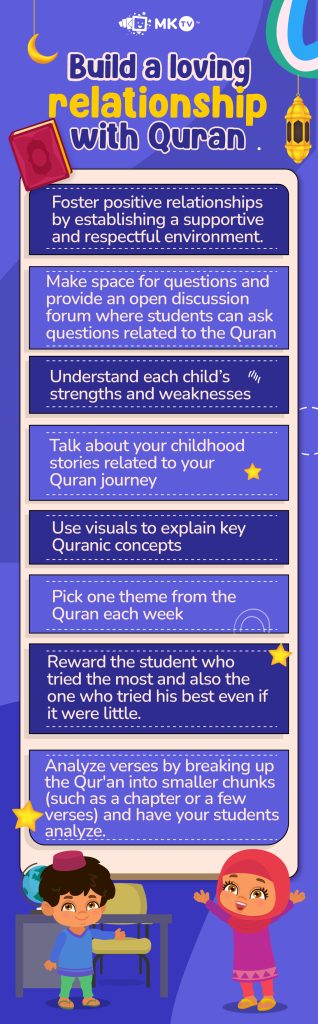
- Build a loving relationship with Quran
Children should develop a strong affinity towards Islam, Quran and Allah out of love and respect, not out of fear or compulsion. The best way to do this is to create a positive and encouraging environment around the Quran for your students.
- Talk more about rewards rather than punishments.
- Talk more about the wonders of Jannah for each good deed they perform rather than the horrors of Hellfire for a small mistake they commit.
- Let them know that we have plenty of halal alternatives rather than stressing upon a handful of haram that they must avoid.
While these tips seem very ordinary, they can have an incredible impact on the minds of young ones.
- Foster positive relationships:
Establish a supportive and respectful environment among your classroom so that students feel comfortable voicing their opinions during discussions about Islam and its teachings from the Quran. When you allow children’s curiosity to bloom, they will be more open to learning about a particular topic as opposed to forcing concepts upon them.
- Make space for questions:
Provide an open discussion forum where students can ask questions related to different interpretations of Quranic verses, discuss their own personal experiences with reading the text, or express any doubts they may have regarding religion-related topics discussed in class.
- Understand each child’s strengths and weaknesses
When introducing the Quran in a Muslim classroom, it is important to understand each child’s individual capabilities, limitations, strengths and weaknesses. Tailor activities to fit the needs of each student and be aware of their learning speed. Make sure not to pressure or push students beyond what they can handle or cause them to feel anxious about the topic. Furthermore, recognize students who are exceeding expectations while providing encouragement to those struggling so everyone in the class will benefit from your lesson plan.
- Talk about your childhood stories:
When you reminisce about your childhood days and how you recited the Quran, the students would be more excited to share theirs because now, they are able to connect with you on a personal level. One of my favorite stories from the Quran was that of Prophet Musa (AS), who led his people out of Egypt and freed them from slavery by splitting the Red Sea. Reading about his courage and strength reminded me that no matter what life throws at us, we will remain strong and emerge victorious as long as we have faith in Allah’s plan. Drawing from stories of the Quran and how you applied them in your life will help students understand that the Quran is not just a Book, but a miracle that transcends time and space.
- Use visuals to explain key concepts:
Utilize colorful visuals such as infographics, diagrams or timelines to explain complex concepts mentioned throughout the Quran, such as scientific miracles or prophecies that have been fulfilled.
- Pick one theme each week:
We have several themes in the Quran that can be applied in daily life. Patience, perseverance, humility, justice, fairness, gratitude, forgiveness, seeking Allah’s protection, prophetic miracles and scientific theories are just some of the many themes in the Quran that have amazed the young and old alike. Use these themes to help your students connect to the Quran better.
Choose a theme, divide your students in 4-5 groups and ask them to:
- Find suitable verses about the particular theme in the Quran.
- Connecting one name/attribute of Allah to that particular theme and learn its meaning.
- Come up with ways on how you can use that particular name of Allah while making dua.
- Search relevant ahadeeth that could be applicable for the particular theme.
The choices here are endless. By doing so, not only will students learn about various aspects in the Quran with ease, but will also learn about what lessons/points of view their friends have derived for each theme, allowing endless discussions that nurtures and nourishes young minds, helping them get closer to the word of Allah.
- Rewards:
Everyone loves to be recognized and rewarded. Don’t make Quran learning a form of competition but a form of encouragement so everyone yearns to do better. Reward the student who tried the most and also the one who tried his best even if it were little.
Talk to your students about the hadith where the one who recites a single letter of the Quran will be rewarded with ten rewards, while those who struggle to learn and act on its teachings will be given an even greater reward. Such ahadith motivate children to build a deeper meaning with the Quran without anyone feeling left out or disheartened.
- Analyze verses:
Break up the Qur’an into smaller chunks (such as a chapter or a few verses) and have your students analyze each one. Ask questions such as what Allah is trying to convey or how a particular verse applies in our modern world. Make sure to emphasize how relevant it is today and how it has shaped Islamic culture over centuries. Open ended questions can lead to jaw dropping discussions because you will be amazed at how children’s minds work.
Research has consistently shown that positive attachment to the Quran leads to increased levels of spiritual well-being, self-esteem, and mental health. Reciting verses from the Quran can result in enhanced cognitive performance due to increased attentiveness while reading. Studies have also revealed that individuals with a strong connection to the Quran tend to practice more Islamic activities such as prayer, fasting and hajj, as well as display more altruistic behavior.